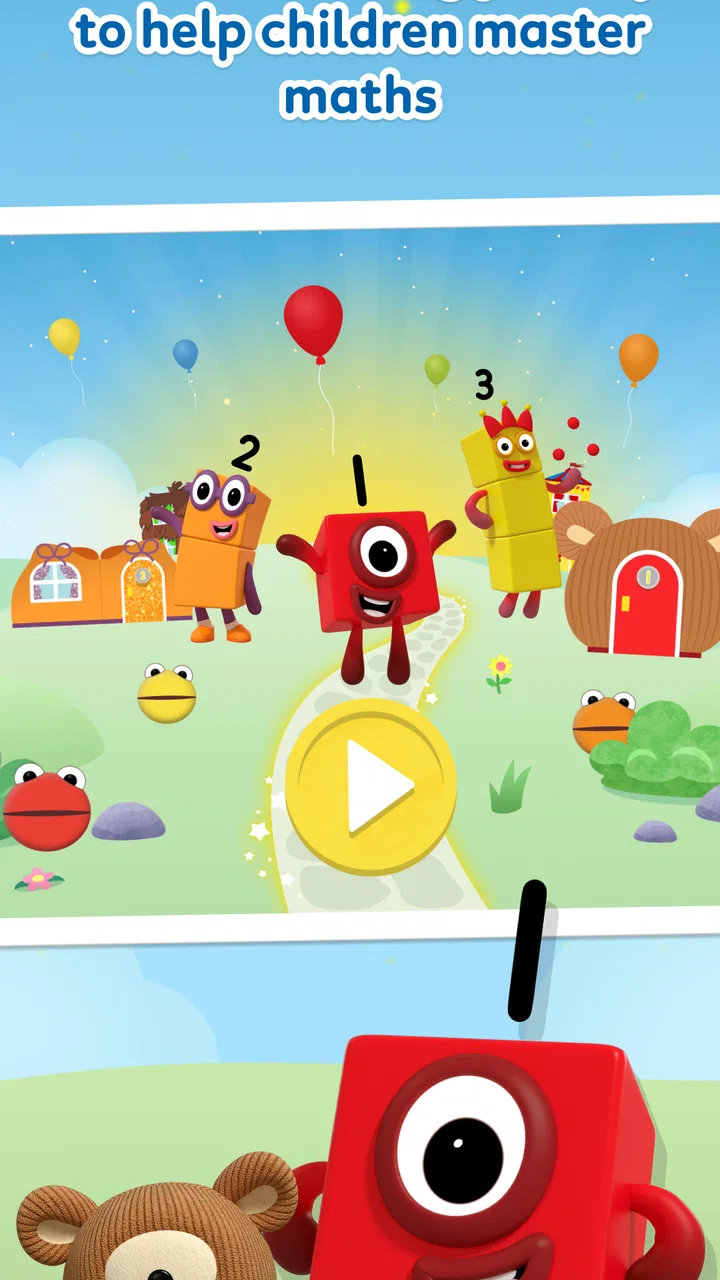
Numberblocks World
- 3.5
- Rating
- 5.00M
- Installs
- Free
- Price

 Analysis by App-foxy
Numberblocks World is the kind of educational game I would put in front of a young learner when I want maths practice to feel more like play than a worksheet. It comes from Blue Zoo and is built around the Numberblocks idea, with activities intended to make numbers easier to recognise, count and work with. The game is free to install, rated for Everyone, and has passed the one-million-install mark, so it is clearly aimed at a broad family audience rather than older students looking for advanced mathematics.
After spending time with it, my view is positive but measured. The presentation makes early number work approachable, especially for children who respond well to colourful characters and short interactive tasks. At the same time, parents should look beyond the word “free”: individual in-app purchases range from $4.99 to $14.99, and that spending context matters when deciding whether the game fits a child’s routine. I also think it is more useful as a playful supplement than as a complete maths course.
How Numberblocks World turns early maths into play
The strongest part of the experience is its ability to give basic maths a friendly setting. Instead of presenting numbers as isolated symbols, it uses the Numberblocks world to make them feel like things a child can meet, recognise and manipulate through play. That matters for younger learners, because attention often disappears when an activity feels like correction or testing.
You May Also Like

 Blood Strike: 2.5 Anniversary
Blood Strike’s Loadouts Turn Every Drop Into a Tactical Gamble
A close look at Blood Strike’s custom loadouts: how fast access to signature weapons reshapes its battle royale rhythm, rewards preparation, and narrows the gap between fights.

 Pandora - Music & Podcasts
Pandora’s Music Is Easy to Start, but Harder to Recover
Pandora’s strength is its low-effort path from a seed to a station. Its weak spot is how much confidence it asks you to place in connection, setup, and quiet recovery.

 8 Ball Pool
 Is Built on Rivalries, Rematches, and Routine
A close look at the rivalries, rematches, shared routines, and unanswered safety questions that turn a quick pool match into a persistent mobile community.

 Samsung Music
’s Quiet Strength Is Playing What You Already Own
Its reach comes less from spectacle than from dependable access to a personal library. That simplicity is both the app’s strongest retention engine and its ceiling.

 AccuWeather: Weather Radar
AccuWeather Review: A Quick, Clear Forecast for Everyday Decisions
For everyday plans, the best forecast is the one you can understand quickly. AccuWeather makes rain timing, radar, and local conditions easy to act on, with a few trade-offs.

 Hill Climb Racing
Why Hill Climb Racing Still Turns Crashes Into One More Run
A tiny car, a bumpy hill and one more upgrade: Hill Climb Racing keeps resurfacing because its simple chaos makes every near-miss feel personal.
More From Our News Desk



I found the game most suitable for children who are still building confidence with counting and number recognition. A child who enjoys repeating familiar characters and visual patterns may be willing to try an activity several times without seeing that repetition as formal practice. That is a real advantage over a plain flashcard app, where the educational purpose can become obvious and tiring very quickly.
The store summary calls it a way to master maths through fun, but I would interpret that carefully. It is a gentle entry point, not a replacement for explanation from a parent, teacher or older sibling. When a child makes a mistake, the game can keep the mood light, but an adult may still need to explain why an answer works. I would sit nearby during the first sessions, not to take over, but to notice which ideas are comfortable and which ones cause hesitation.
That shared use also reveals a practical strength: the game can become a conversation starter. Rather than asking only whether an answer is right, I can ask a child to describe how they recognised a number or what they noticed on the screen. Those small questions turn passive tapping into more meaningful practice. The app does not have to carry the entire lesson by itself.
A good fit for short, repeatable sessions
I would not treat Numberblocks World as something a child needs to use for a long uninterrupted sitting. Its value is clearer in small sessions that fit naturally around the day. A few activities after breakfast, a quiet period before dinner or a short turn while travelling can work better than announcing a large “maths lesson.” The playful format is especially helpful when the child is willing to begin but loses interest in traditional exercises.
One realistic routine would be to let a child play for a short period, then move away from the screen and continue with real objects. If the game has prompted counting, I might ask the child to count fruit, socks or toy pieces. This gives the digital activity a purpose beyond the device. It also helps reveal whether the child understands the idea or is simply following visual cues.
That is one of my more useful tips for this particular game: use it as the first step in a two-part activity. The app provides an inviting introduction, while ordinary objects provide a chance to transfer the idea into daily life. Parents who only watch the score or completion state may miss whether the learning carries over once the screen is gone.
What the free starting point means for families
The free price makes it easy to try without committing money at the outset. That is valuable for parents who are unsure whether their child will connect with the Numberblocks style. I would install it, watch how the child approaches the first activities, and decide based on actual engagement rather than on the character branding alone.
However, “free” should not be confused with “everything included.” The game offers in-app purchases priced between $4.99 and $14.99 per item. I appreciate having a clear purchase range, but families still need to make their own decision about whether any extra content is worth buying. I would avoid presenting an upgrade as a reward for persistence, because that can make spending feel like part of the child’s progress rather than an adult choice.
For a shared family device, I would check purchase controls before handing it over. I would also decide in advance whether the child is allowed to ask about additional content, so the session does not become a negotiation every time an unfamiliar option appears. This is not a criticism of a particular purchase screen; it is simply sensible practice whenever a free children’s game includes paid items.
The purchase range also changes how I judge value. A single low-cost addition may be reasonable for a child who uses the game regularly, while several purchases could make the total feel less attractive compared with a one-time educational title. Since the items are sold individually, I would make each decision separately and avoid assuming that buying one means the whole experience is unlocked.
Progress without turning maths into pressure
Educational games can accidentally make children focus more on completing a sequence than on understanding the idea behind it. Numberblocks World works best in our routine when progress is treated as a guide, not a demand. If a child keeps returning to a familiar activity, I see that as useful practice rather than evidence that the child must rush toward something harder.
My advice is to observe the type of mistake being made. If the child chooses quickly but cannot explain the answer away from the screen, the activity may be encouraging recognition without enough understanding. In that situation, I would pause the game and recreate the question with household objects. If the child is slow but can explain the reasoning, I would not treat that as failure. Speed is not the same as mathematical confidence.
This approach reduces pressure and makes the app more welcoming for different learning styles. Some children enjoy repeating a task until it feels automatic; others need a break before returning. I would let the child’s attention decide the length of a session rather than using the game as a test of endurance.
There is also a useful distinction between motivation and reward. Characters, movement and familiar visual language can motivate a child to begin. That is different from promising a purchase, extra screen time or praise for every correct answer. Keeping those things separate helps the child associate maths with curiosity instead of with constant external prizes.
Fairness: what matters in a non-competitive maths game
Numberblocks World is not the sort of title I would choose for competition between children. Its educational value is personal progress: recognising numbers, trying an activity and becoming more comfortable with early maths. That makes fairness less about leaderboards and more about whether every child gets a reasonable chance to learn without feeling compared with a faster sibling.
I would be cautious about turning completion into a family contest. A child who needs more repetition should not be made to feel behind because another child moves through an activity quickly. The game is better used as an individual practice space, with adults celebrating explanations and persistence rather than simply counting how much has been finished.
Spending fairness is equally important. If one child receives paid content and another does not, the difference can become visible even when the educational need is similar. I would set a household rule that purchases are chosen by the adult and discussed openly. That keeps access from becoming a reward system and prevents the child who asks most often from automatically receiving more.
Compared with competitive quiz games, this is an area where Numberblocks World has a natural advantage. Early learners do not need the distraction of rankings to practise counting. Compared with a physical workbook, though, the app can make screen time feel more attractive than slower activities that require drawing, writing or handling objects. I would use both formats, because the digital game is engaging while paper and real-world play reveal different kinds of understanding.
Where it sits beside other educational choices
Against a standard maths worksheet, Numberblocks World is more inviting for a child who avoids written work. It offers a visual and character-led route into the subject, which can be the difference between starting an activity and refusing it. The trade-off is that a worksheet gives an adult a clearer view of what the child can write independently, while an interactive game may hide whether an answer came from reasoning, memory or trial and error.
Against a general-purpose learning platform, this game feels more focused on the early-number stage and less like a broad curriculum. That focus can be a benefit for a young child who needs repetition without being surrounded by unrelated subjects. It becomes less suitable when the learner needs substantial written arithmetic, detailed explanations or a structured path through more advanced topics.
Against free videos, the interactive format has the potential to keep a child involved rather than simply watching. But videos can be easier for an adult to preview and discuss, while an app puts more responsibility on the family to supervise the experience and decide how paid content fits the budget. I would choose Numberblocks World when participation matters, and a video or book when I want to slow down and explain a single idea carefully.
Device details and practical expectations
The game was released on July 8, 2020, and its current version is 2.4.11. It requires Android 8.0 or later, so families using an older Android device should check compatibility before planning around it. That requirement is not especially demanding for a modern phone or tablet, but it can matter with an older hand-me-down device that a child uses as a dedicated learning screen.
The public response is mixed rather than perfect: it holds an average rating of 3.6 from around 6,400 ratings, alongside 292 written reviews. I would not use that number alone to reject it, because children’s apps are judged by different families with different expectations about content, pacing and purchases. Still, it is a useful reminder to approach it as a try-first download, not as an automatic recommendation for every household.
The scale of adoption, with more than one million installs, tells me that the concept has reached many families, but popularity does not settle the value question. The important test is whether the child in front of you stays engaged and whether the activities support conversations away from the screen. A widely installed app can still be the wrong match for a child who prefers writing, physical games or quieter instruction.
I would also leave a little time for setup and observation rather than handing over the device during a rushed moment. Children’s apps can feel simple to adults while presenting a lot of visual information to a young learner. Watching the first session helps identify whether the child understands what to do, becomes distracted by the presentation or needs help navigating between activities.
Questions I would settle before installing
Is it appropriate for a preschool or early-primary learner? The Everyone rating and the early-number focus make it a reasonable candidate for young children, but the right age still depends on the child’s existing skills and attention. I would use it with a child who enjoys visual play and is beginning to explore counting, not with an older learner seeking formal algebra or exam preparation.
Can it replace a teacher or maths workbook? I would say no. It can make practice more appealing and give a child extra exposure to number ideas, but an adult still adds explanation, correction and real-world examples. If a child is struggling with a particular concept, I would not assume that repeated app use alone will solve the problem.
Will the free version be enough? That depends on what the child enjoys and how much of the available experience is useful to your family. Because individual items cost from $4.99 to $14.99, I would begin with the free entry point and only consider a purchase after seeing a sustained reason to use it. I would not buy simply because a child has completed the free material once.
Is it fair for a shared device? Yes, if adults keep control of spending and avoid comparing children by speed or completion. The game’s educational purpose is better protected when each child can repeat activities at a comfortable pace. A family rule about purchases and turns will do more for fairness than any score-based reward.
Who should skip it? I would look elsewhere if the learner needs advanced maths, extensive writing practice, detailed progress reporting or a fully structured course. I would also skip it for a child who becomes frustrated by character-led presentation or who already learns better through manipulatives and direct adult instruction. In those cases, blocks, counters, books and teacher-guided work may be more effective.
My trust verdict for families
Blue Zoo has made a game that can give early maths a warmer, less intimidating starting point. I like its strongest use case: a child plays briefly, notices number patterns and then talks about them with an adult or applies them to ordinary objects. That workflow makes the app more valuable than simply using it as a way to occupy a child.
My reservations are mainly about expectations and spending. The free installation is useful for testing the fit, but the presence of individual purchases means parents should make the financial decision themselves. The average rating of 3.6 suggests a mixed experience across the wider audience, so I would pay attention to how it works on your own device and with your own child rather than relying on popularity.
Overall, I would recommend Numberblocks World to families looking for a playful introduction to early maths, especially when a child responds to familiar characters and visual activities. I would keep sessions short, connect screen activities to real objects, and treat progress as practice rather than pressure. My honest recommendation is to try the free experience first, keep purchases adult-controlled, and use the game alongside—not instead of—conversation, books and hands-on counting.
FAQs for Numberblocks World
01What is Numberblocks World and who is it suitable for?
Numberblocks World is an educational app designed to teach children about numbers and basic math concepts. It is based on the popular TV series, "Numberblocks." The app is suitable for children aged 3 to 6 years old, making it a great tool for early learners to engage with math in a fun and interactive way.
02What features does Numberblocks World offer?
Numberblocks World offers a variety of features including interactive games, puzzles, and animated content that align with the educational objectives of the Numberblocks series. The app provides a hands-on approach to learning, helping children understand number sequences, counting, addition, and subtraction through engaging activities and storytelling.
03Is Numberblocks World available on both Android and iOS?
Yes, Numberblocks World is available for download on both Android and iOS devices. Users can find it on the Google Play Store for Android devices and the Apple App Store for iOS devices, making it accessible to a wide range of users across different platforms.
04Does Numberblocks World require an internet connection to play?
Numberblocks World does not require a constant internet connection for all its features. Once downloaded, many games and activities can be accessed offline. However, some features may need internet access for updates or additional content, so it's recommended to have periodic internet access for the best experience.
05Is there a cost associated with Numberblocks World?
Numberblocks World offers a subscription model with a free trial period. Users can explore the app and decide if they wish to continue with a paid subscription to unlock all content. The subscription ensures regular updates and access to new educational materials and features, providing ongoing value for users.
Pros
- Engaging educational content for kids.
- Colorful and interactive animations.
- Wide variety of math games and puzzles.
- Safe and ad-free environment.
- Regular updates with new content.
Cons
- Limited offline functionality.
- Subscription required for full access.
- May be too simplistic for older kids.
- Initial setup can be confusing.
- Requires stable internet connection.

Numberblocks World
Gallery